
The route
The Salem Sites We Walk, In Order
Nine documented locations between the Salem Visitor Center and the Old Burying Point — the real addresses behind the stories, and the reason each one made the route.
Nine stops · 1.5 hours · downtown only
Every stop is a place you could visit on your own. The tour is what makes them mean something.
Spellbound does not visit "haunted" locations chosen for atmosphere. Each stop is on the route because something documented happened there, or because something unexplained has been reported there consistently enough to investigate. The walk stays inside the old downtown, so the distance between stops is short and the history is dense.
-
The Revere Bell at the Salem Visitor Center
The walk begins outside the Salem Visitor Center on Essex Street, beside a bell cast in Paul Revere's foundry. It is the last piece of the old waterfront you can stand next to without leaving downtown — a useful place to start a story about a city that made its money at sea and then spent a century explaining what came home with it.
-
The field where Giles Corey was pressed to death
In September 1692, an 80-year-old farmer named Giles Corey refused to enter a plea to the charge of witchcraft. Under English law that refusal allowed the court to apply peine forte et dure: he was laid in a field and weighted with stones for two days until he died. The site is unmarked, ordinary and easy to walk past, which is exactly why the tour stops there.
-
The site of the Witch Dungeon
The jail that held the accused during the trials stood here. Contemporary accounts describe it as overcrowded, freezing and fetid, with prisoners chained to the walls. Salem later refused to reuse its timbers — a detail that says more about the city's memory of 1692 than any monument does.
-
The haunted Lyceum, now Turner's Seafood
The Salem Lyceum opened on Church Street in 1830 as a lecture hall; Alexander Graham Bell demonstrated the telephone here in 1877. It is a restaurant now, and for decades staff and diners have described the same recurring figures in the same parts of the building. Dr. Vitka has investigated the reports, and he will tell you which ones hold up.
-
Old Town Hall
Salem's 1816 market house and the ballroom used in Hocus Pocus. The film made the building famous, but the stranger material is in the building's own history — the civic business conducted upstairs, and what people working alone in the hall after hours have reported since.
-
The Boston Strangler's Salem murder site
One of the darkest addresses on the route. The 1960s killings attributed to Albert DeSalvo remain contested, and the Salem case in particular is still argued over by people who study the files. The tour presents the evidence and the doubts rather than a tidy ending.
-
The police station where Houdini performed
Harry Houdini brought his escape act to Salem, and the city's police department was part of the show. The story of the cell that was supposed to hold him is a useful reminder that Salem has been in the business of staging the impossible for a very long time.
-
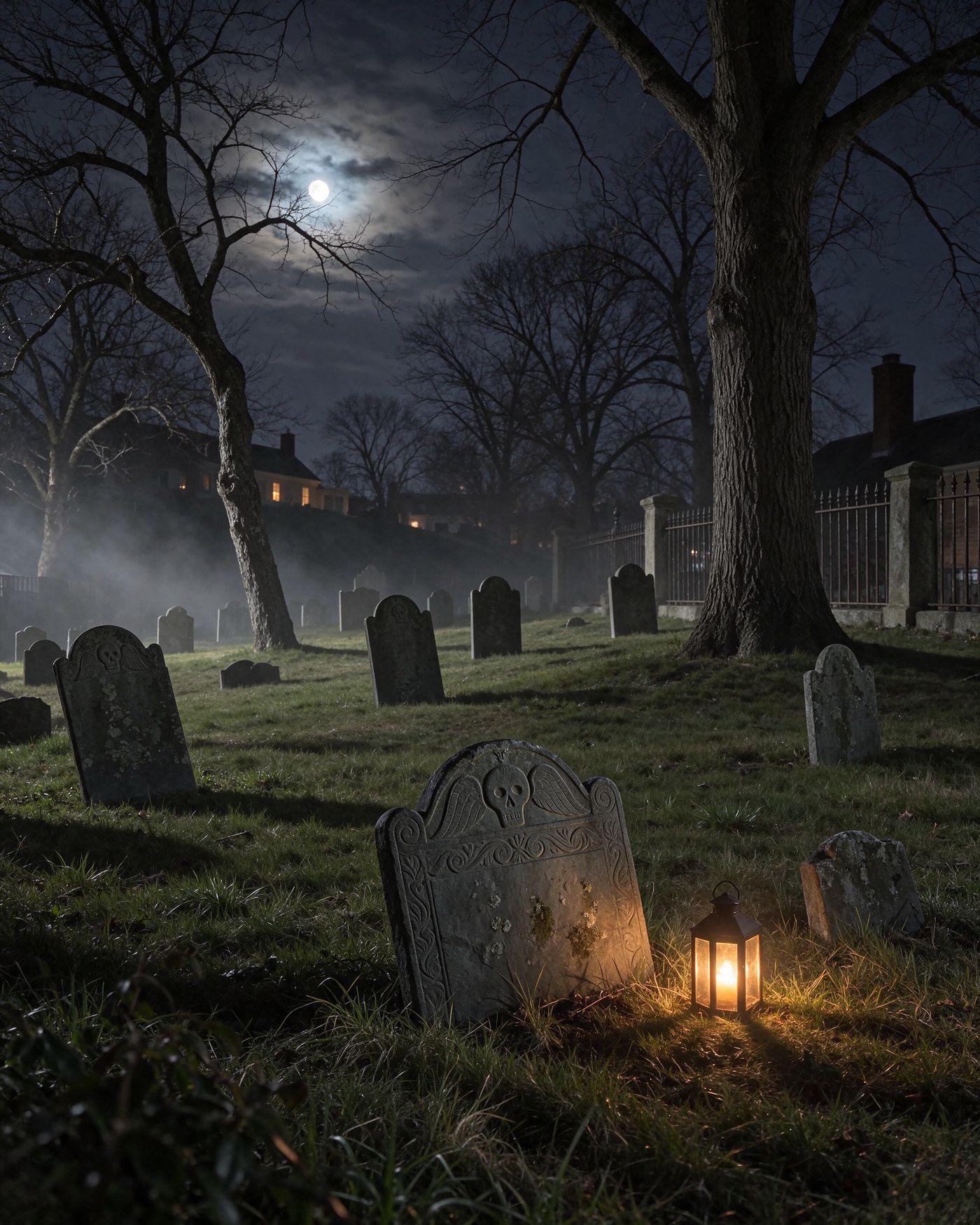
Old Burying Point and Charter Street Cemetery
Salem's oldest burying ground opened in 1637. It holds Mayflower passenger Richard More, a great many merchant captains, and Judge John Hathorne — the 'Hanging Judge' of 1692 — whose epitaph is conspicuously silent about the trials. His descendant Nathaniel Hawthorne added the 'w' to the family name and spent a career working through the shame.
-
The Peabody Essex Museum
The walk ends with a story about the museum's collection and the building it sits in — one of those details that is hidden in plain sight on Essex Street. The tour then returns to the Visitor Center, where Dr. Vitka reviews the ghost photographs guests have sent in.
Where the walk goes
A compact loop through the old city
The route begins and ends at the Salem Visitor Center on Essex Street, which means you finish where you started and never need a car between stops. Expect about a mile and a half of walking over 90 minutes, with frequent pauses.
Groups move at a pace that works for children and for anyone who would rather stand than stride. There are curb cuts at the crossings we use; if you use a wheelchair or a stroller, call ahead and we will talk through the night's route and the easiest place to join.
An honest omission
Why we do not take guests to Gallows Hill
Almost every Salem tour ends at Gallows Hill Park. Spellbound does not, and the reason is simple: the park is almost certainly not where the executions happened.
The true site was contested for three centuries. In 2016 a research project concluded that the gallows stood at Proctor's Ledge, a rocky outcrop between Boston Street and Proctor Street — now a quiet residential memorial. Gallows Hill Park was named for the legend rather than the evidence, and the city's own records were deliberately vague about the location at the time.
Dr. Vitka will tell you the full story on the walk, including why the confusion suited Salem for 300 years.
Reserve your place
Walk the route with the person who investigated it.
The Spellbound Tour runs nightly from the Revere Bell at the Salem Visitor Center. From $28 per person, all ages, rain or shine.
Nightly tours · All ages · Rain or shine · (978) 740-1876